The Truth About Real Balsamic Vinegar: Why Modena's DOP Tradizionale Only Comes in a 100ml Bottle
I need to tell you something that will change how you look at your pantry: the "balsamic vinegar" on your shelf — even the expensive one from the gourmet store — is almost certainly not balsamic vinegar. Not the real thing, anyway.
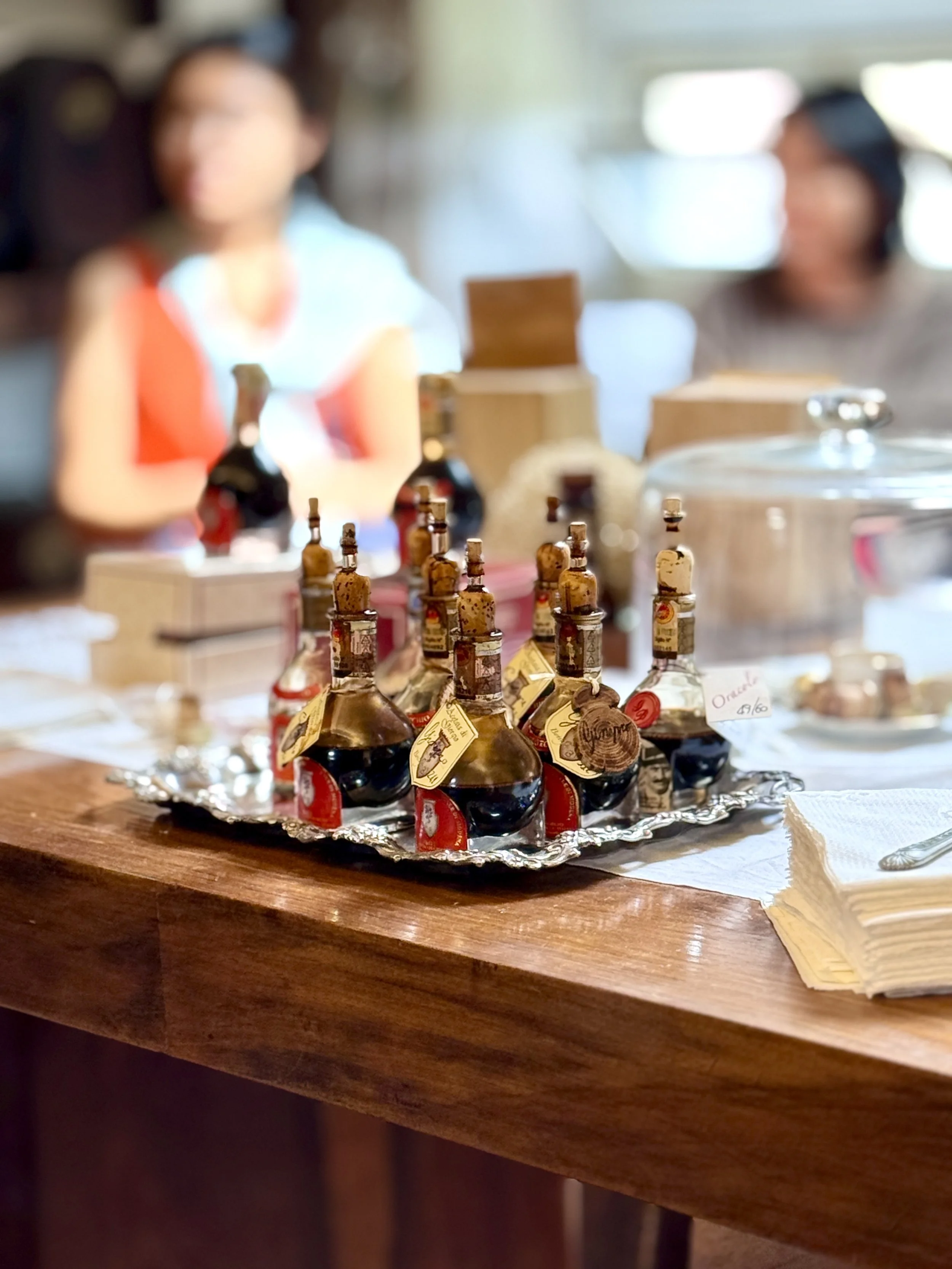
The real thing is called Aceto Balsamico Tradizionale di Modena DOP, and it is one of the most fiercely protected foods on earth. It contains exactly one ingredient. It cannot legally be sold until it has aged for a minimum of twelve years. And it is only ever sold in one container: a sealed, numbered, 100ml bottle.
We learned all of this standing in a 150-year-old attic in Modena, surrounded by hundreds of barrels, on a tour at Acetaia di Giorgio — and it's an experience I now build into nearly every Emilia-Romagna itinerary I design.
First, the uncomfortable truth about your "balsamic"
Most of what's sold worldwide as balsamic is Aceto Balsamico di Modena IGP — a different product with a different (and much looser) designation. It's typically wine vinegar mixed with grape must and often caramel coloring, produced in industrial quantities and aged briefly, if at all. It's not bad — it has its place on a salad — but it's related to the real thing the way grape juice is related to Brunello di Montalcino.
Traditional balsamic — the DOP — is one ingredient: cooked grape must. Local grapes, primarily Trebbiano and Lambrusco, are pressed and the must is slowly cooked down over an open flame. Then time does the rest. No wine vinegar. No caramel. No shortcuts. Nothing else is permitted, and an independent consortium exists to make sure of it.
How it's actually made: the batteria
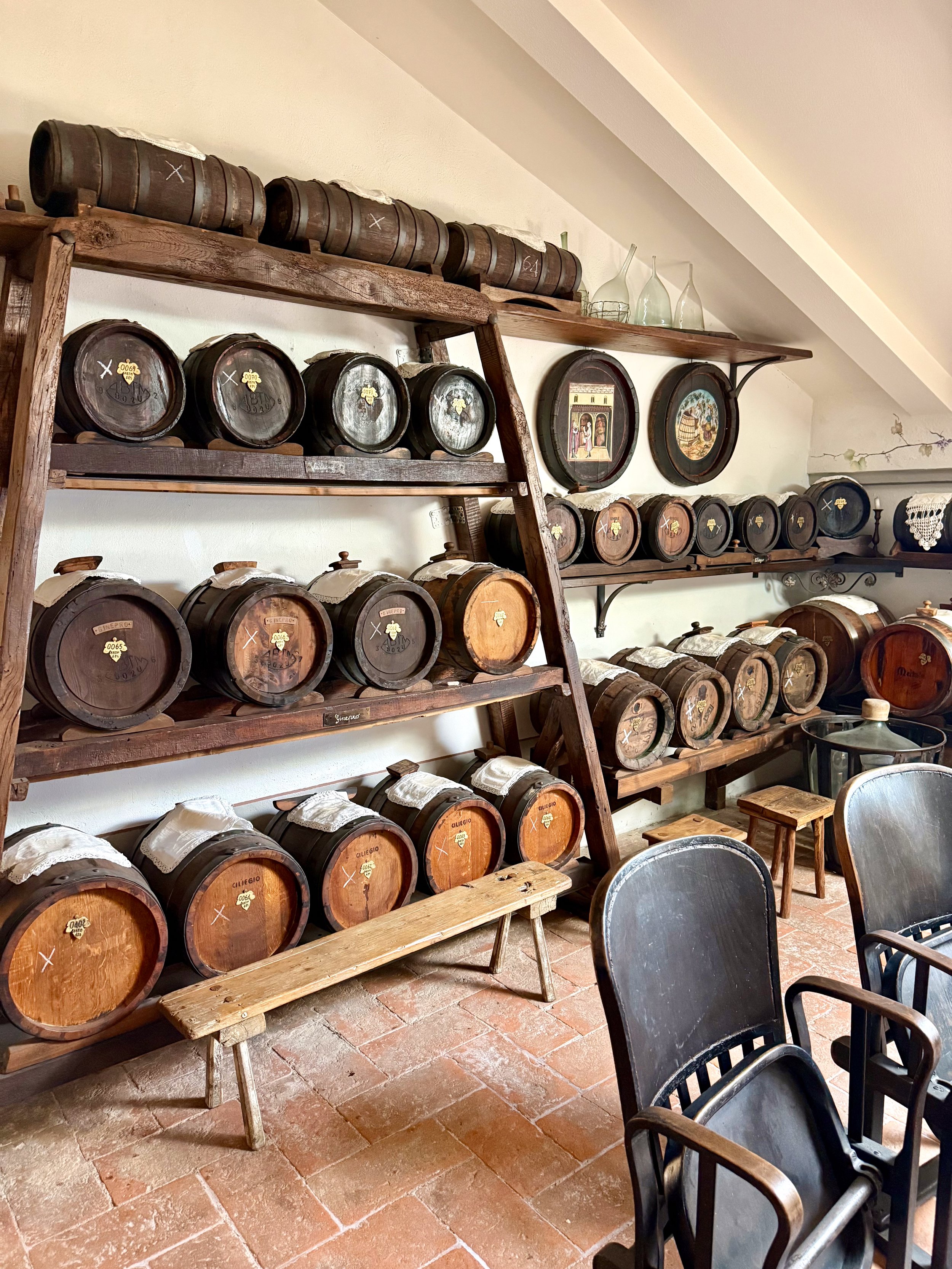
Here's where it gets beautiful. Traditional balsamic ages in a batteria — a series of at least five wooden barrels of decreasing size, each made from a different wood: oak, chestnut, cherry, mulberry, juniper, ash. Each wood lends its own character to the vinegar as it moves through the line.
The barrels live in the attic — never a climate-controlled cellar — because traditional balsamic needs Modena's brutal seasons. The scorching summers drive evaporation and concentration; the cold winters let the vinegar rest and clarify. The attic is the recipe.
Once a year, in winter, comes the ritual of travasi e rincalzi — the transfers and toppings-up. A small amount is drawn from the smallest barrel (this is the finished vinegar), the smallest barrel is topped up from the next one up the line, and so on, with fresh cooked must entering only the largest barrel. The vinegar moves slowly down the battery over years and decades, concentrating as it goes. The barrels are never emptied and never washed — some batterie have been running continuously for over a century, which means every drop contains a trace of vinegar started by someone's great-great-grandparents.
12 years vs. 25+ years: Affinato and Extravecchio
The DOP recognizes exactly two products:
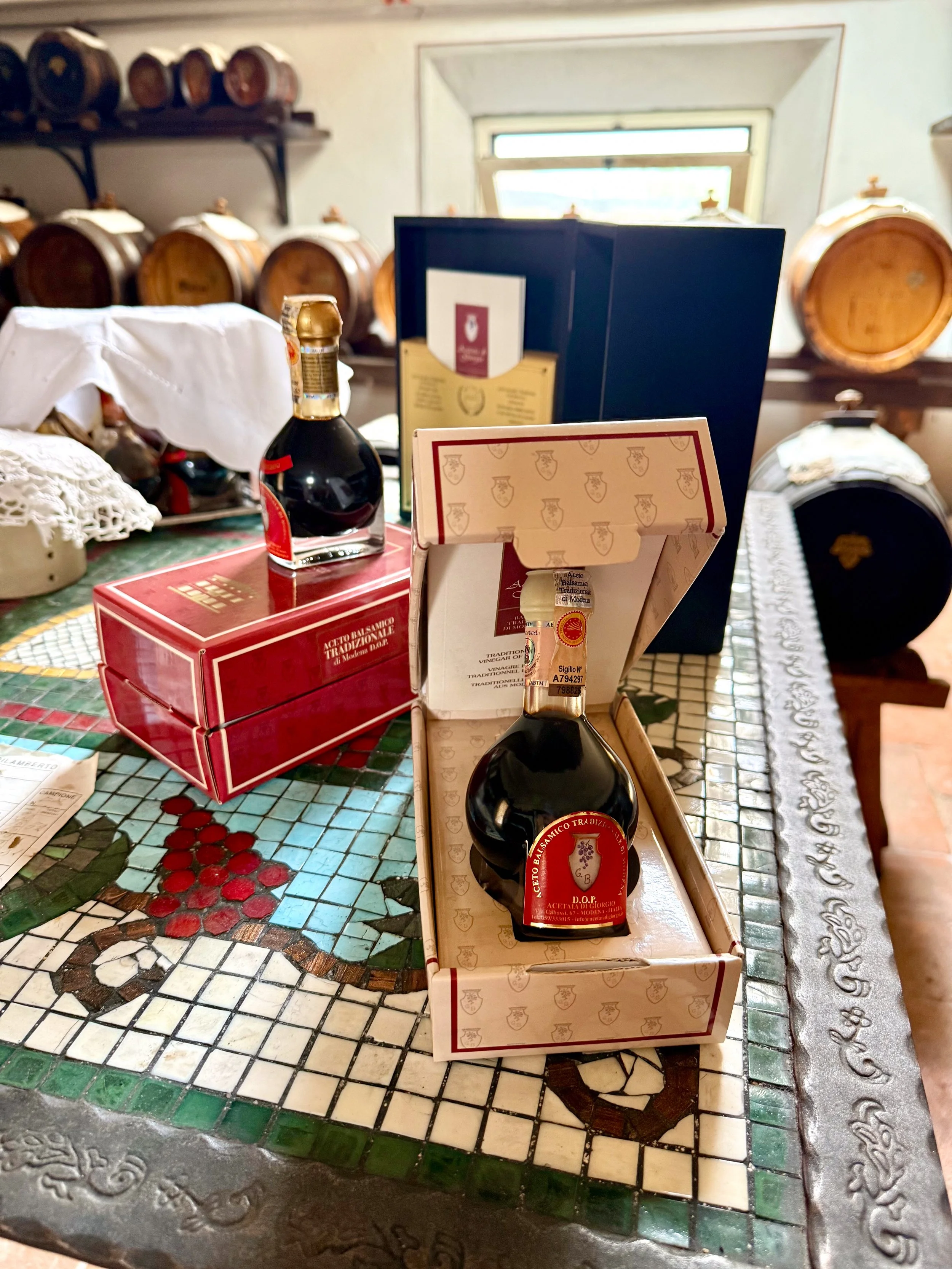
Affinato (minimum 12 years) — aged at least twelve years through the battery. Glossy, dense, sweet-and-sharp, alive with the wood. This is the one for everyday reverence: a few drops over Parmigiano Reggiano, on risotto, over strawberries.
Extravecchio (minimum 25 years) — a quarter century or more in the barrels. Thicker, darker, almost syrup, with extraordinary complexity — fig, molasses, wood, time itself. This is not a condiment; it's a meditation. It's traditionally taken in drops from a small spoon, often at the end of a meal, and a single 100ml bottle can run €100 or more. It's worth every euro, because you're tasting 25 years of someone's patience.
And here's the part that gets me: the yield is almost absurd. Hundreds of kilograms of grapes, cooked down and aged for decades, produce just a few liters of finished vinegar per battery per year. This is why real balsamic is precious — and why a bottle lasts years, because you use it by the drop.
Why the 100ml bottle matters
This is the detail that tells you everything about how seriously Modena takes this. Traditional balsamic DOP can only be sold in one bottle: a 100ml vessel designed by Giorgetto Giugiaro — yes, the legendary car designer, which is the most Modena thing imaginable in the land of Ferrari, Maserati, and Lamborghini.
But it goes further. Producers can't even bottle it themselves. Every batch must be submitted to the consortium, where a panel of master tasters blind-evaluates it. Only if it passes is it bottled — at the consortium, in the official bottle, sealed and numbered, with a cream-colored capsule for Affinato and gold for Extravecchio (Reggio Emilia's parallel DOP has its own bottle and its own rules).
So here's your shopping rule for life: if it's not in the 100ml Giugiaro bottle, it is not traditional balsamic. No exceptions. Any "aged balsamic" in a tall bottle, any "barrel-aged" anything in 250ml — that's IGP or less, whatever the price tag says.
Our visit to Acetaia di Giorgio
You can read all of this, but you can't understand it until you climb the stairs into a working attic acetaia — and the one I send my clients to is the one we toured ourselves: Acetaia di Giorgio, a few minutes from Modena's center.
The setting alone is worth the visit: a villa built in 1870 by the fourteen Barbieri brothers and sisters, where the family has lived — and made vinegar under the roof — ever since. Today it's run by Giorgio Barbieri and his family. Giorgio is a former Italian national volleyball player who, after his athletic career, turned fully to the tradition that ran in his family's blood (and their rafters). The family history is everywhere in the barrels: their grandfather, a hunter, built a battery of juniper casks because he wanted a spicier vinegar for venison, alongside a cherry-wood battery for sweetness — and those batteries are still producing.
What stays with you is how personal it all is. In Modena, a batteria is not equipment; it's a family member. Batteries are traditionally started at the birth of a child and given as wedding dowries. Standing among the barrels, you realize you're looking at a family's autobiography written in wood and time.
The tour ends the only correct way: tasting. Affinato and Extravecchio, drop by drop. Tasting a 12-year and a 25-year side by side is the moment the entire tradition snaps into focus: same single ingredient, same attic, and two completely different worlds.
I was so impressed to watch Leila (who is currently only 5 years old) participate in every round of the tasting and share her opinions on her favorites. Of course, her favorite was a €130 25-year extravechio ciliegia (cherry), which we bought and have been enjoying back at home.
How to do this yourself (or let me arrange it)
Modena deserves at least two or three days on your Emilia-Romagna itinerary. Between the acetaie, the Parmigiano dairies, Mercato Albinelli, and a food scene that ranges from market stalls to Massimo Bottura, a day trip is insufficient. A proper acetaia visit takes about an hour and must be arranged in advance, and pairing it with a Parmigiano Reggiano caseificio visit in the same morning is one of the best food-culture day in Italy, full stop.
This is exactly the kind of experience Fatto a Mano Travel exists for: small, family-run, genuinely traditional, and impossible to fully appreciate without context. This is what we mean when we talk about sustainability: supporting the local artisans who make Italy the incredible country she is. Every bottle bought directly from a producer like the Barbieri family supports a craft that industrial "balsamic" has been undercutting for decades. If you want Modena done right — the acetaia, the dairy, the right tables — I'd love to design it for you. Fatto a mano, like the balsamico.
Author bio: Michael Gallagher is the founder of Fatto a Mano Travel. He has been traveling through Italy for 15 years, twice lived in Florence, speaks Italian, and returns every year.